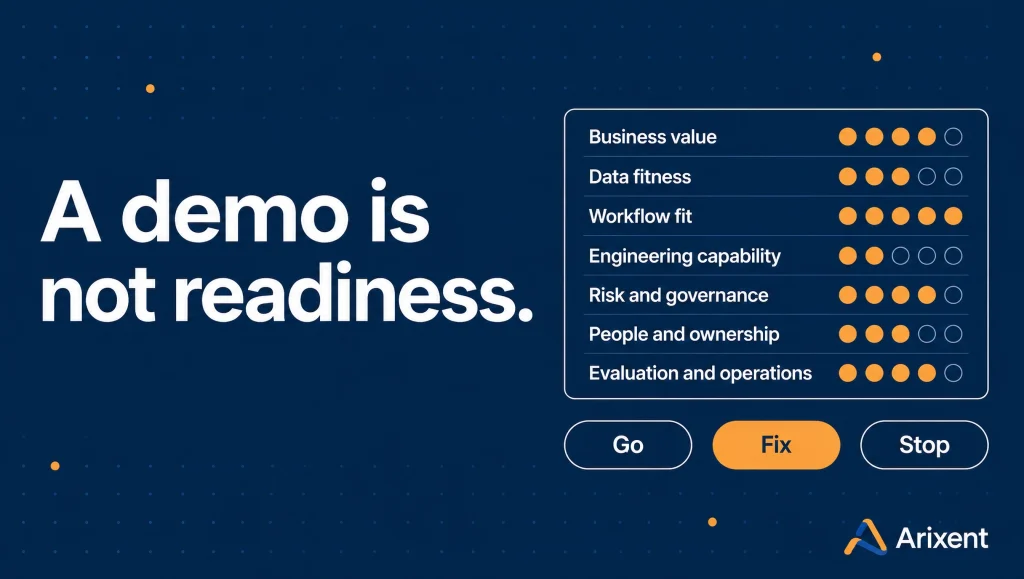
Evaluating AI for companies comes down to one question: can this use case run in production, on your data, under your controls, at a cost that makes sense? A convincing demo answers none of that. Readiness is evidence that the system improves a real workflow without adding cost or risk you cannot carry.
A good assessment ends in a decision, not a maturity score. Proceed with a bounded pilot, fix a named prerequisite, or stop. It also names who owns the outcome and what evidence would justify the next dollar.
This guide gives you a practical scorecard, the gates that cannot be averaged away and a four-week plan to run it. It is a working tool, not a certification. Use it to stop piloting and start shipping.
Start with one business workflow
A company can be ready for an internal document assistant and nowhere near ready for autonomous customer refunds. One maturity score for the whole organization hides that difference. So do not assess the company. Assess the workflow.
Pick one. Write a short use-case brief: who uses it, what goes in, what comes out and what happens when it is wrong. Describe the current process before you describe the replacement.
"Improve customer support with generative AI" is not a use case. "Draft replies to product configuration questions from approved documentation, with a support specialist approving every reply" is. You can test the second one. You cannot test the first.
Record the baseline while you are there: handling time, rework, escalation rate and what the process costs today. Then ask the uncomfortable question. Would better search, clearer rules or plain automation solve this more simply?
This is use case prioritization done properly. It turns AI for companies into an operating decision instead of a shopping trip. You now have a system boundary, a number to beat and an alternative to compare against.
AI for companies: score seven readiness dimensions
Score each dimension on a four-point scale. The scale separates what is written down from what has been shown to work.
- 0, unknown or missing: No reliable evidence exists.
- 1, documented: A plan, policy or capability is described but untested.
- 2, tested: Verified on representative samples in a controlled setting.
- 3, demonstrated: Works under the intended operating constraints, exceptions included, with an accountable owner.
Score the use case, not the company's reputation or its technology budget.
| Dimension | Evidence to inspect | Warning sign |
|---|---|---|
| Business value | Workflow baseline, beneficiary and a measurable outcome | Success is defined as "using AI" |
| Data fitness | Representative records, usage rights, data quality checks and access rules | A polished sample hides missing or restricted data |
| Workflow fit | Process map, exception paths and human handoffs | Nobody knows what happens after a wrong output |
| Engineering capability | Integration test, deployment path and identity controls | The prototype runs on copy and paste |
| Risk and governance | AI risk management assessment, approval responsibilities and incident procedures | Review is scheduled for after launch |
| People and ownership | Business owner, technical owner and user testing | A sponsor exists but no operational owner does |
| Evaluation and operations | Test cases, production monitoring plan, support arrangements and rollback procedure | Accuracy rests on a handful of good examples |
Write down the evidence behind every score. A scorecard attached to real artifacts is an AI readiness assessment. A scorecard built from stakeholder confidence is a survey, and surveys do not ship.
Inspect evidence, not architecture slides
For each dimension, name the evidence owner, where the evidence lives and when it was last verified. Mark unknowns as unknowns. Do not turn them into optimistic assumptions because the meeting is running long.
Pull a representative data sample and make sure it includes the hard cases: incomplete records, outdated documents, conflicting instructions and restricted information. If the data is labeled, check that the labels reflect the actual business decision. Keep the evaluation examples away from the examples used to tune the system.
Data governance is where most of these reviews slow down, and that is useful information. Our piece on why an AI roadmap is also a data roadmap explains how to connect a use case to the data it depends on.
Test the organization the same way. Ask the operational owner who reviews exceptions, approves changes and pays the recurring bill. Ask the intended users to walk through a task on the proposed process. Watch where they hesitate.
Readiness for AI for companies gets clearer when answers are demonstrated rather than described. A connector specification is weaker evidence than a passing integration test. An approved policy is weaker than an access control that actually blocks an unauthorized request.
Set nonnegotiable gates before you read the scores
Do not average away a critical failure. Strong business value and enthusiastic users do not compensate for unauthorized data access. Some findings are gaps. Some are gates. Know which is which before you add anything up.
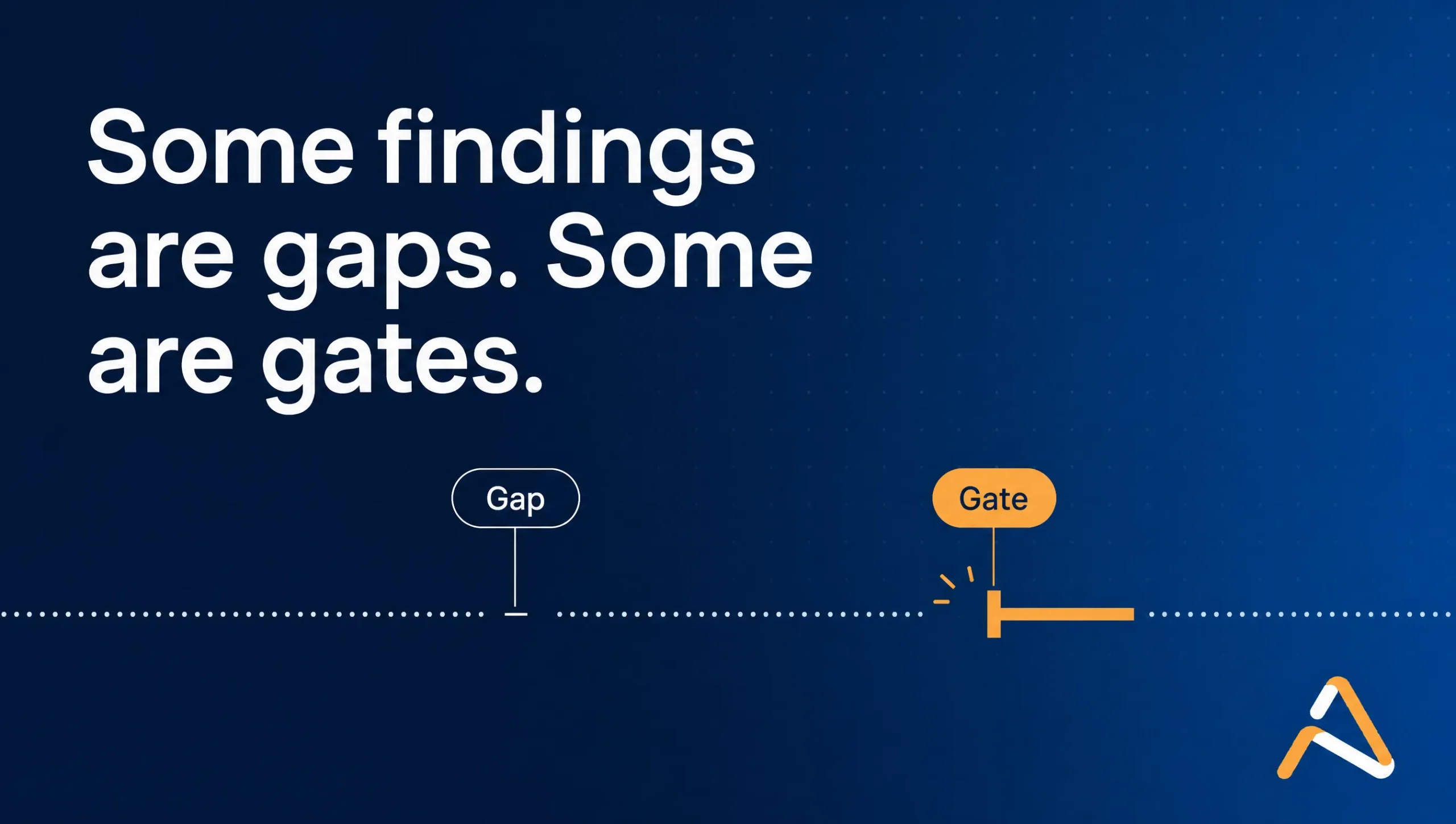
For a system that touches confidential information, authorized access and approved handling rules are gates. For a system that affects consequential decisions, human oversight, escalation paths and domain-specific review are gates too.
The NIST AI Risk Management Framework gives you a recognized structure for the governance and risk work. It is voluntary guidance, not proof that your deployment is compliant or safe.
Controls have to match the intended behavior. A drafting assistant and an agent that changes customer records need different permissions and different failure handling. Our article on where AI agents earn their keep draws the line between generating a response and completing an operational task.
For generative systems, test for prompt injection, sensitive information disclosure and excessive permissions. The OWASP Top 10 for Large Language Model Applications is the security reference to work from.
Missing production controls do not have to stop all experimentation. They do have to confine it to an approved sandbox, with suitable data and no path to real-world actions. That is how AI for companies moves past the demo stage without betting the company on it.
Check whether the business case survives production costs
Model usage is the cost everyone quotes and rarely the one that matters. Integration, data preparation, AI evaluation, human review, production monitoring and ongoing maintenance decide the total cost of ownership. Count all of it.
Use a simple operating model:
Net recurring value = realized operational benefit + incremental contribution margin – recurring operating costs.
Track implementation costs separately so decision-makers can see payback and funding needs. Do not count the same benefit twice. Saved handling time and reduced staffing spend are usually one change wearing two labels.
The economics of AI for companies rest on realized benefit, not on the number of outputs generated. Time saved is capacity, not cash. Say how that capacity turns into value: higher throughput, less overtime, a hire avoided or a deliberate staffing change.
Estimate low, expected and high scenarios with explicit assumptions. Include review effort, exception rates, workload growth and the chance that you will need a more expensive model or more controls than planned.
A use case is financially ready when someone owns those assumptions and the pilot can test the ones that matter most. If the case only works with perfect accuracy, zero review and instant adoption, revise it before you fund a build.
Test readiness in a bounded pilot
A pilot should answer the investment questions you still have, not prove that a model can produce plausible text. That was never in doubt.
Back to the support example. Use an approved set of product questions. Include ambiguous and out-of-scope requests on purpose. Compare the assisted workflow against the current one. Keep a separate evaluation set that nobody used to refine prompts or pick configurations.
When you test AI for companies, measure the whole workflow and not the model response alone. Faster drafting is worth nothing if checking sources and fixing errors takes longer than writing the answer from scratch.
Agree on pilot acceptance criteria before the first test run:
- Task performance: Correctness, completeness and appropriate refusal or escalation.
- Workflow impact: End-to-end handling time, review effort and rework.
- Control performance: Access enforcement, auditability and safe handling of failed dependencies.
- Operating fit: Latency, cost per completed task and support workload.
Set thresholds against the baseline and the cost of being wrong. There is no universal accuracy percentage that makes every use case ready. Rare but severe failures need targeted tests, and a small pilot cannot prove they are impossible.
Document the pilot's limits next to its results. Success with one product line or one language says nothing about every customer segment.
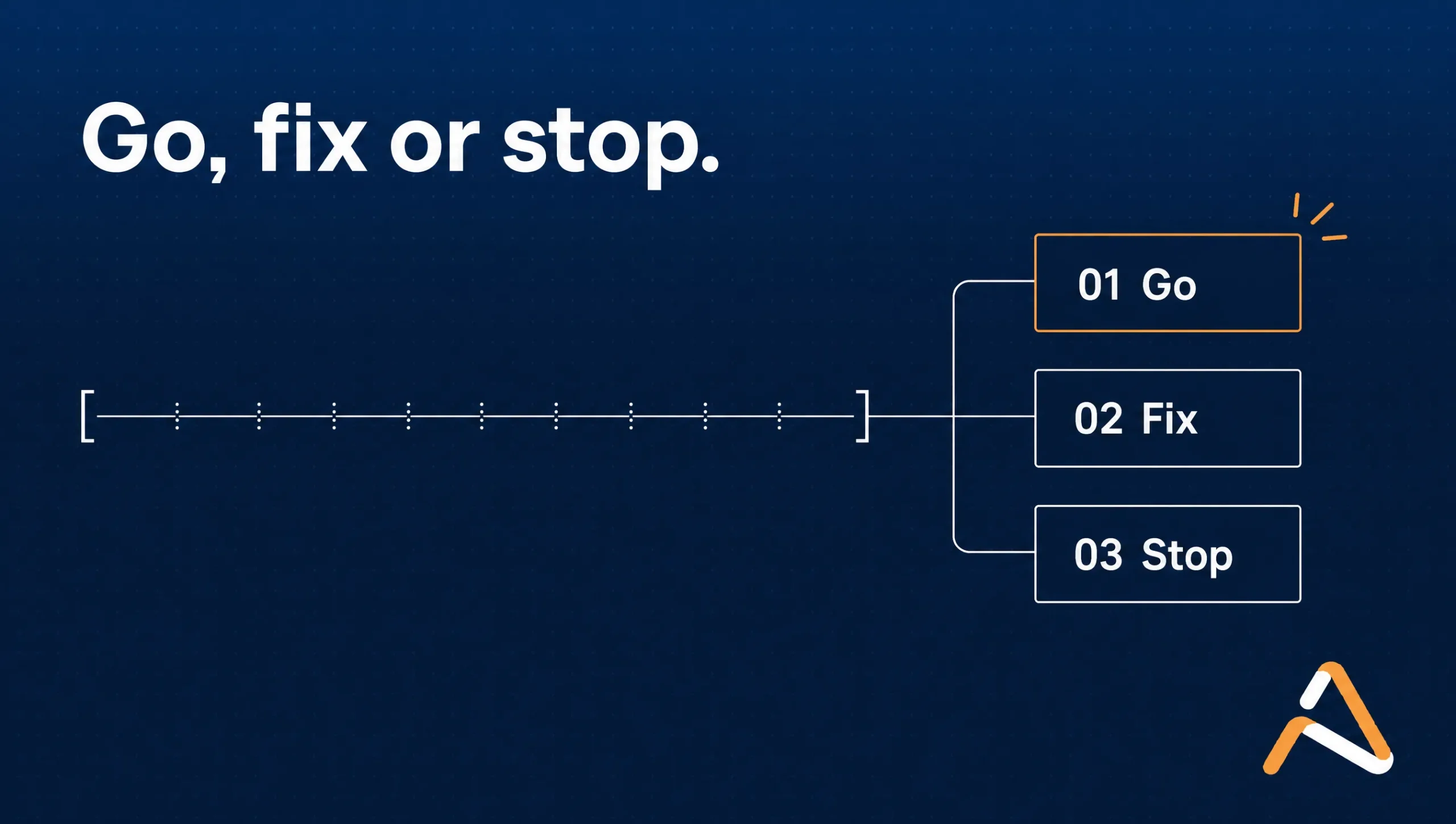
Turn findings into a go, fix or stop decision
The seven scores are not a pass mark. They are the evidence for one of three decisions about the next stage.
Go: proceed within a defined boundary
Proceed when the critical gates for the next stage are met, the value hypothesis holds up and the remaining unknowns can be tested safely. Write down the permitted users, data, actions and workload limits.
Approval for a pilot is not approval for production. Every expansion should revisit the assumptions that change with scale or consequence.
Fix: remove a specific blocker
Pause when a fixable prerequisite is missing. Give it an owner, a completion criterion and a review date. "Improve data quality" is not a finding. "Resolve the conflicting product eligibility rules in the approved knowledge source" is.
Stop: reject an unsuitable use case
Stop when a simpler solution wins, when the required data cannot be used lawfully or responsibly, or when realistic operating costs exceed achievable value.
Stopping one use case is not stopping AI. It keeps investment in AI for companies tied to demonstrated readiness, which is how the next use case gets funded without a fight.
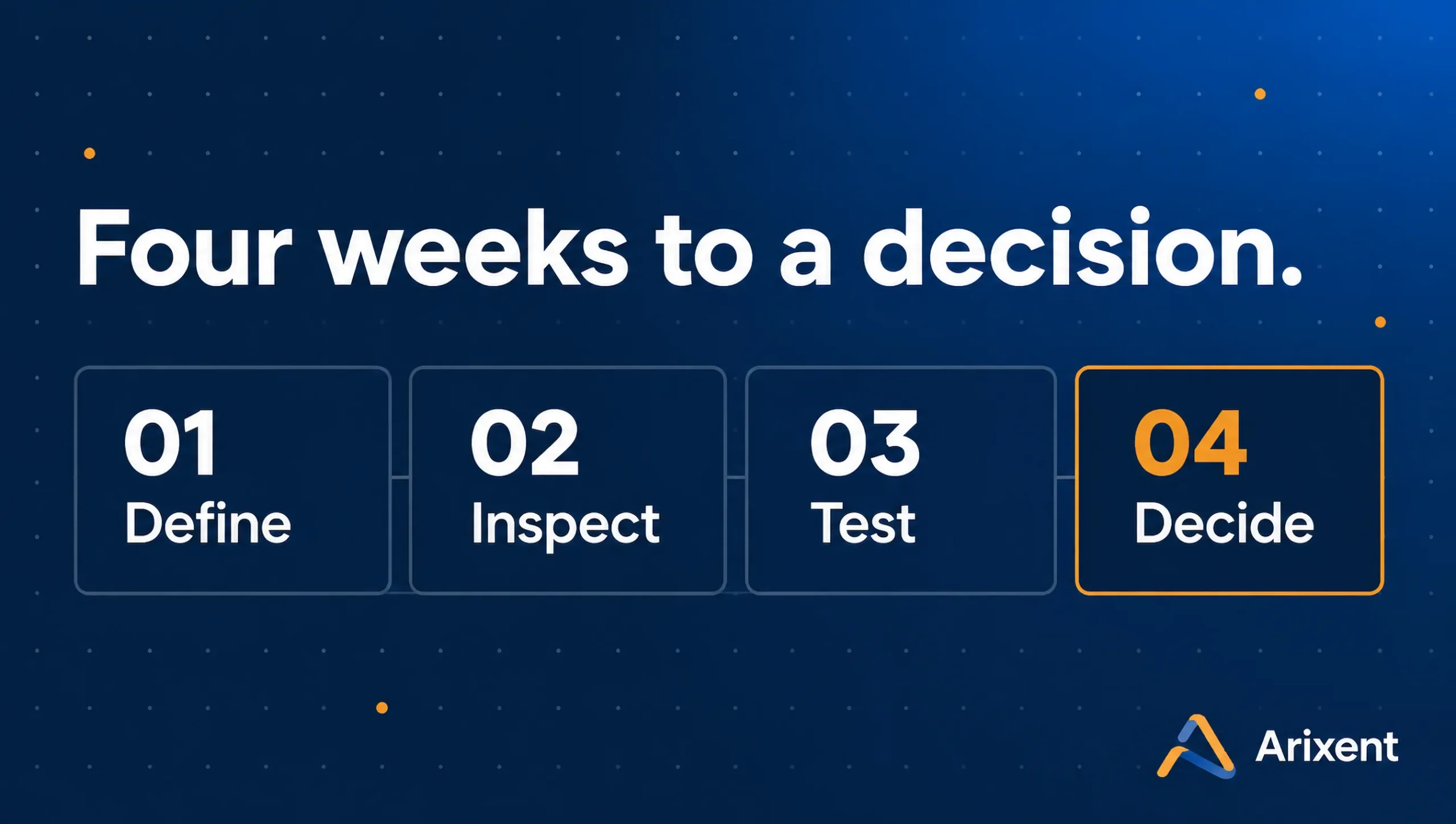
Run the assessment over four weeks
For a bounded use case with available stakeholders, four weeks is a useful timebox. Complex procurement, regulated workflows or hard data access will take longer. Treat the schedule as a plan, not a promise.
| Period | Main work | Decision artifact |
|---|---|---|
| Week 1 | Define the workflow, baseline, owner and non-AI alternative | Use-case brief and initial value hypothesis |
| Week 2 | Inspect data, integrations, permissions and operational responsibilities | Evidence-backed scorecard and blocker register |
| Week 3 | Run targeted feasibility tests and review risks with the right stakeholders | Test results, cost assumptions and control requirements |
| Week 4 | Resolve conflicting findings and agree on the next investment | Go, fix or stop recommendation with owners and criteria |
A short assessment of AI for companies should end in an investment decision, not another presentation. Keep the final package usable: scorecard, evidence, open risks, business case and the boundaries of the next stage.
Where evidence is still missing, say how the gap affects the decision. A missing integration test might justify a technical spike. Uncertain data rights might block work on that data entirely.
Choose the delivery model after you know the gaps
Build versus buy is the question most teams ask first. Ask it last. The scorecard should tell you whether to buy, build or bring in an engineering partner. Starting from a preferred vendor bends the whole assessment toward whatever that vendor happens to sell.
Buy when the workflow is common and the product meets your security, workflow integration and operating requirements. Build when the workflow is yours alone, or when you need real control over behavior and integration. Bring in a partner when the internal team lacks the capacity or the specialist skills to close the gaps you found.
Deciding how to deliver AI for companies comes after deciding what the business must own. Hold every option to the same evidence: access controls, representative test results, total operating cost, support responsibilities and exit options.
Whatever you choose, keep an internal business owner who can accept trade-offs and authorize changes. External delivery never transfers accountability for your workflow or your customers.
Frequently asked questions
What is an AI readiness assessment? An evidence-based review of whether a defined use case has the business justification, data, engineering capability, controls and ownership it needs for its next stage. The output is a decision with conditions, not a maturity score.
Can a company start without perfect data? Yes, if the available data suits the bounded task and can be used under the right controls. Missing or inconsistent data becomes a blocker when it undermines required performance, lawful use or safe operation.
Does AI readiness require an in-house machine learning team? No. AI for companies often runs on existing products or outside engineering support. The company still needs accountable ownership, suitable technical oversight and people who know the workflow well enough to judge the results.
How much does an assessment cost? The cost of assessing AI for companies depends on scope, data access, integration complexity and the specialist review required. Ask for defined evidence and decision deliverables. Do not compare proposals by workshop count or slide count.
Move from assessment to an engineering plan
Arixent is an AI and product engineering company. We do not sell licenses, so we have no reason to push a tool. We start with a working session on one workflow, mark what should be bought and what must be built, and then design, build and run the custom piece alongside your team so they can run it afterwards.
Done in that order, the change does not stop at a tool rollout. That is where teams see up to 80% savings through higher efficiency and productivity.
If your assessment of AI for companies found a viable use case and exposed delivery gaps, talk to Arixent about your AI engineering needs or book a working session. Bring the workflow baseline, the known constraints and the open questions. The next conversation should be about a bounded implementation plan, not another demo.