A model with excellent test results is not automatically software machine learning teams can trust in a live workflow. Production adds everything the notebook never saw: missing fields, customers who change their behavior, a dependency that times out at 2 a.m., privacy rules, and a bill that grows with every request.
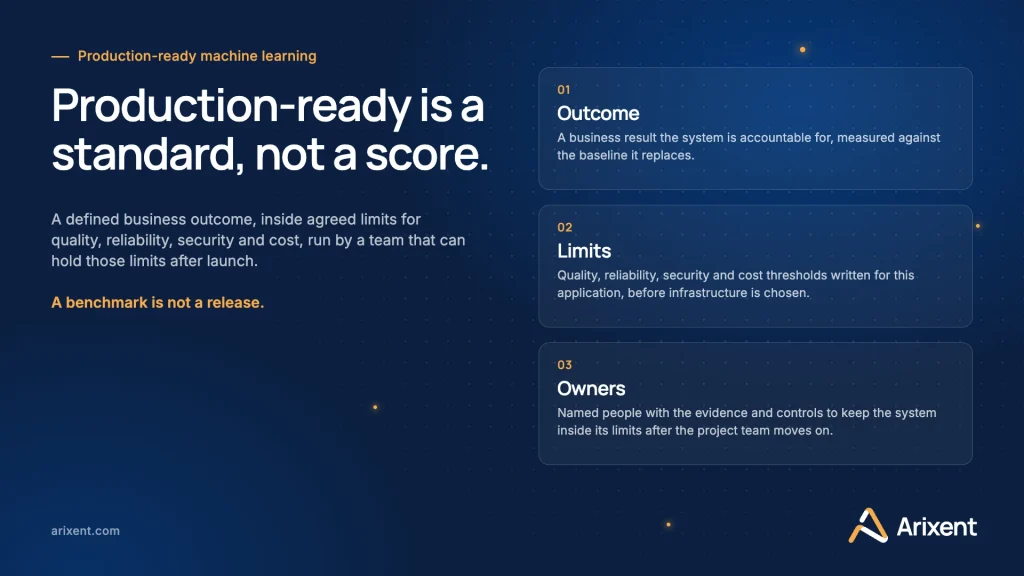
Production-ready machine learning software delivers a defined business outcome inside agreed limits for quality, reliability, security and cost, and gives a named team the evidence and controls to hold those limits after launch. That is the standard we hold our own work to, whether the system is a demand forecast, an invoice classifier or a product built on a third-party model. Here is how to check whether yours meets it.
Define readiness around the workflow, not the benchmark
Start with the decision the system supports. Who reads its output? What happens when it is wrong? Can someone step in before the damage is done?
For an invoice-routing system, ready might mean every document lands in the right review queue and uncertain cases get escalated. It probably does not mean the model approves payments on its own.
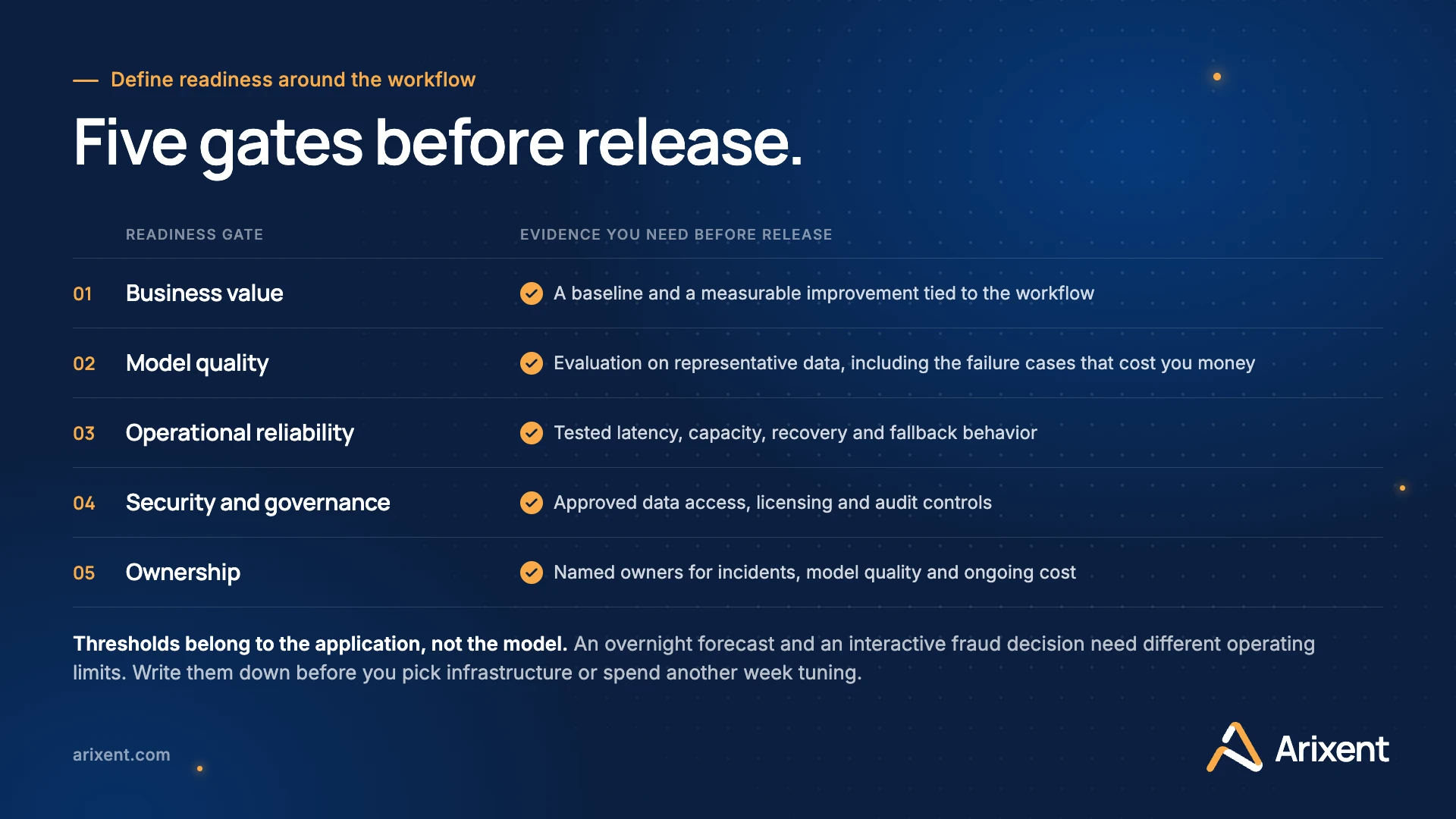
Turn that boundary into release evidence:
| Readiness gate | Evidence you need before release |
|---|---|
| Business value | A baseline and a measurable improvement tied to the workflow |
| Model quality | Evaluation on representative data, including the failure cases that cost you money |
| Operational reliability | Tested latency, capacity, recovery and fallback behavior |
| Security and governance | Approved data access, licensing and audit controls |
| Ownership | Named owners for incidents, model quality and ongoing cost |
Set the thresholds for the application in front of you. An overnight forecast and an interactive fraud decision need different operating limits. Write those limits down before you pick infrastructure or spend another week tuning the model.
Build software machine learning teams can reproduce
A good training run has to become a traceable release artifact. Another engineer should be able to see how it was produced, confirm how it behaves and deploy it without reverse-engineering a notebook.
Record the training code version, the dependency environment, the configuration, the dataset reference and the evaluation results. Store the model artifact next to its preprocessing logic and input schema. Where exact reproduction is impractical, because of nondeterministic operations or an external service that keeps changing, say so in writing and define the variation you will accept.
Model reproducibility does not require a particular platform. A small team can start with version control, immutable storage and an automated build pipeline. Larger systems usually grow into a model registry, workflow orchestration and tighter access controls. The MLOps tooling matters less than the discipline it enforces.
The test is operational: can someone other than the original author rebuild or recover the approved release?
Google's Rules of Machine Learning makes the same point from a different direction: reliable infrastructure and consistency between training and serving come before clever algorithms. We agree. Sophistication layered on an unstable delivery process is how pilots stall.
Treat data as a versioned production dependency
Data lineage should connect source records to the transformations and software machine learning pipelines actually use. Without that link, you cannot tell a change in predictions from a change in the source data, and you will spend the incident arguing about which one it was.
Define input contracts: field types, required values, allowed ranges, freshness and what happens when data is missing. Then decide what a contract failure does. Reject the request, quarantine the batch, use an approved fallback or send it to a person.
In the invoice example, a missing supplier identifier should trigger explicit handling, not quietly become a default value that changes where the document goes.
Training and serving must also compute features the same way. A feature built from final approval status leaks the answer if that status does not exist when a new invoice arrives. A supplier category refreshed daily cannot be treated as current at inference time.
Keep point-in-time correctness in your evaluation sets, and keep records that would leak information out of both sides of the split. Depending on the problem, that means time-based or customer-level splits rather than random sampling.
We covered the broader dependency in why your AI roadmap is a data roadmap. At release time the requirement is concrete: show that the inputs available in production can support the decision you evaluated.
Evaluate the complete application, including abstention
Evaluate the software machine learning models run inside, not just the models. Preprocessing, routing rules, downstream integrations and human review all change the outcome, even when the model itself has not moved.
Compare the system with a meaningful baseline, such as the current rules or the manual process it replaces. Then look at performance by segment. A strong headline number can hide poor results on an unusual document format, a new supplier or a user with little history.
Pick the metric that reflects what errors cost you. Precision, recall, calibration and ranking quality answer different questions. Accuracy alone misleads when the cases that matter are rare.
Test uncertainty handling as part of the product. An invoice classifier can abstain and send the document to review, but your evaluation has to include the review volume that creates, the capacity of the queue and how long completion takes. A fallback that buries the operations team is not a safety mechanism.
For generative applications, extend the evaluation to unsupported claims, prohibited disclosures and tool-use failures. Retrieval quality depends on source freshness and permissions, not only on how fluent the answer sounds. Our guide to what production retrieval requires walks through those dependencies.
Use documented test cases and human assessment wherever an automated score cannot tell you whether an output is acceptable.
Choose infrastructure around constraints, not popularity
Choose software machine learning engineers can run inside your privacy, latency and staffing constraints. A framework's popularity or a platform's training features tells you nothing about whether it fits your production workload.
| Approach | Useful when | What you take responsibility for |
|---|---|---|
| Local or self-hosted infrastructure | Data location, offline operation or hardware control is a firm requirement | Redundancy, patching, capacity, recovery and physical access |
| Self-managed cloud infrastructure | You need flexible deployment and can operate cloud services | Identity, networking, scaling, observability and cost controls |
| Managed ML service | Less infrastructure work is worth the platform's constraints | Data handling, supported runtimes, quotas, portability and provider dependencies |
The categories overlap. A managed service may support private networking. A self-hosted system may still call an external model API.
A workstation is fine for experimentation and a poor shared serving environment. The reverse is also true: a small batch workload may not need an always-on inference service or specialized accelerators.
Check current runtime support, maintenance activity and licensing directly with the projects and providers you choose. Last year's software roundup cannot tell you whether a dependency is still supported or still allowed in your commercial product.
Make deployment reversible before increasing traffic
Versioning the surrounding software machine learning depends on matters as much as versioning the weights. A rollback fails if the previous model no longer accepts the current feature schema or cannot read a changed configuration.
Package each release so the model, preprocessing, configuration and dependencies can be identified together. Test it in a production-like environment with realistic request sizes, concurrency and dependency behavior.
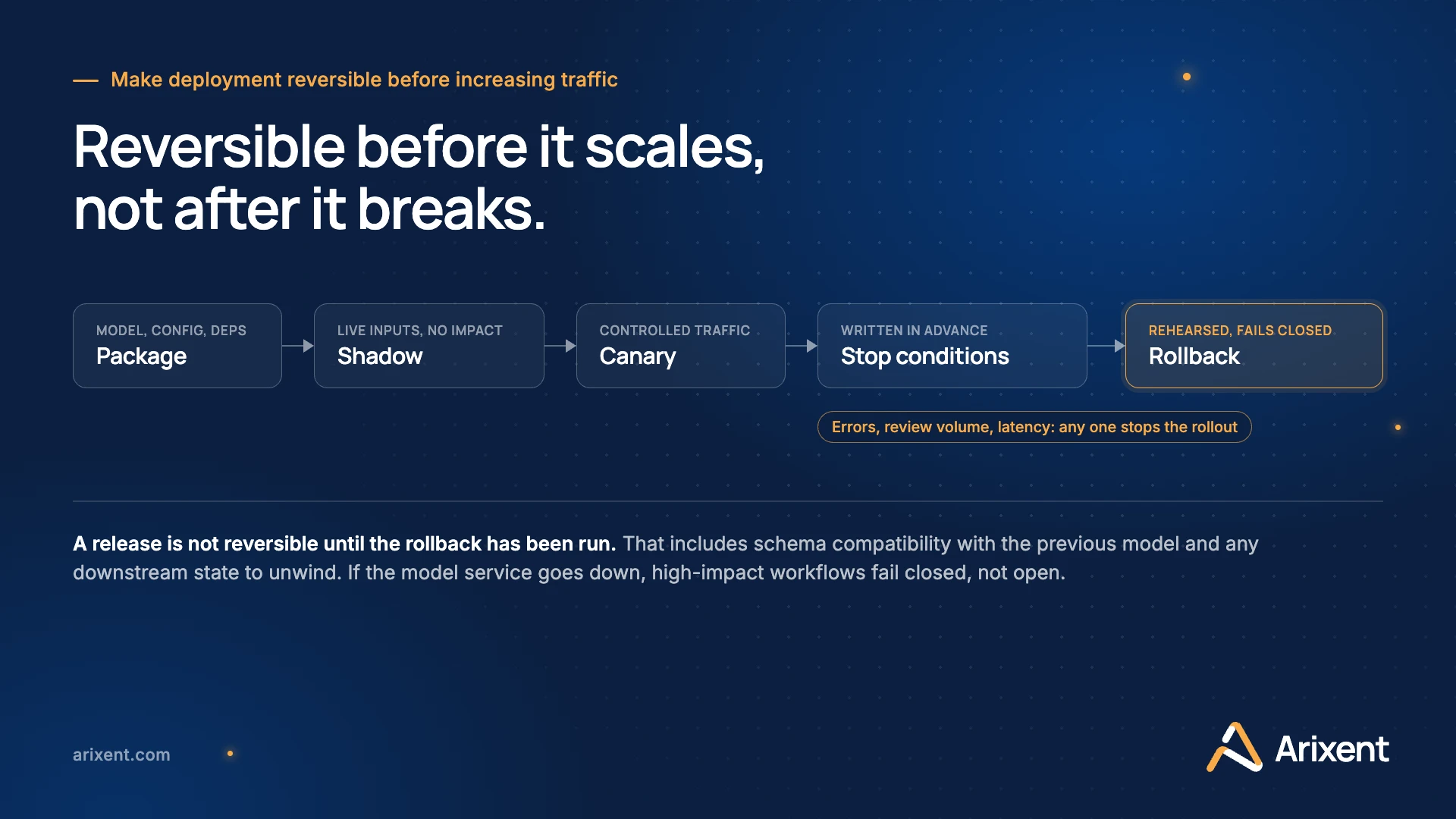
Match the rollout to the risk. Shadow deployment compares predictions on live inputs without changing anyone's outcome. A limited canary release exposes a controlled share of traffic. Neither replaces testing, and shadow results alone say nothing about downstream business impact.
Write the stop conditions before you roll out: application errors above a threshold, an unacceptable rise in manual review, a missed latency objective.
Then test the fallback itself. If the model service goes down, the application might apply approved rules, queue the work or stop automated decisions altogether. High-impact workflows often need to fail closed rather than return a stale or unverified result.
A release is not reversible until your team has run the rollback path, including schema compatibility and any downstream state it has to unwind.
Secure the whole system and verify usage rights
Review the software machine learning teams bring into the stack, not only the model. Dependencies, serialized artifacts, data connectors and serving endpoints all widen the exposure.
Apply least-privilege access, separate your environments, protect secrets and restrict who can publish or replace a model. Treat model files from untrusted sources as untrusted code, especially when the loading mechanism can execute it.
Privacy controls have to reach past the training set. Prompts, inference requests, traces and debug logs carry sensitive information. Decide what may be captured, who can read it and when it is deleted.
Verify rights separately for code, model weights, datasets and third-party services. An open-source framework says nothing about whether a specific model or dataset permits your commercial use. External providers need the same review: retention terms, data location and contractual limits.
For systems that retrieve private information or call tools, test the authorization boundaries and attempts to manipulate instructions. A permission check should never depend on the model following a prompt.
The NIST AI Risk Management Framework gives you a structure for governing AI risk. Use it to shape the process. It is not a substitute for controls and evidence specific to your application.
Monitor reliability, model behavior and business outcomes
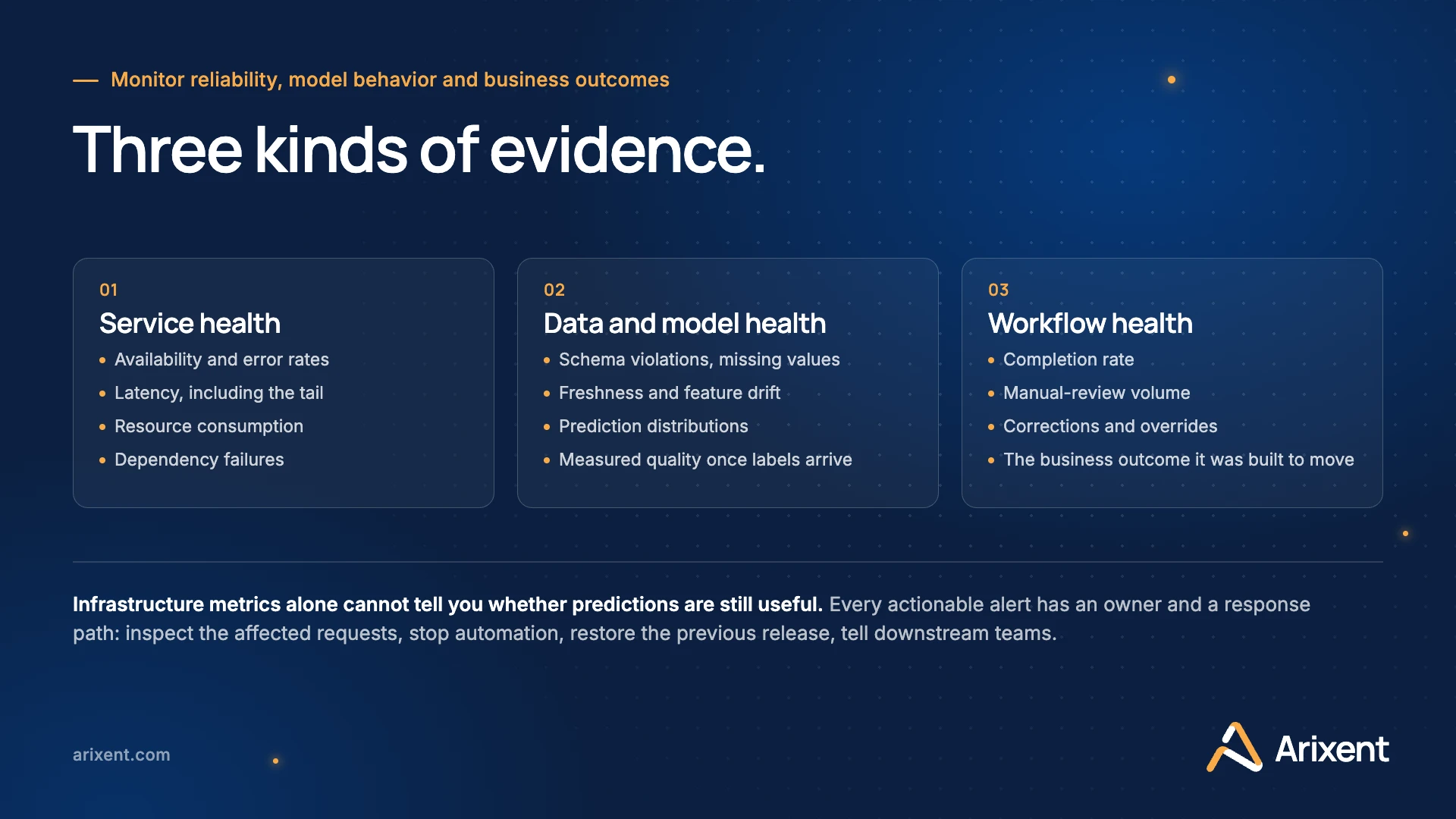
The software machine learning teams operate should produce three kinds of evidence. Infrastructure metrics alone cannot tell you whether the predictions are still useful.
Service health: availability, latency, error rates, resource consumption and dependency failures. Set service-level objectives that match the user's experience, including tail latency where a slow response breaks the workflow.
Data and model health: schema violations, missing values, freshness, feature distributions, prediction distributions and measured performance once labels arrive. Separate input drift from a change in the relationship between inputs and outcomes. Both deserve a look. Neither proves the model got worse.
Workflow health: completion rate, manual-review volume, correction rate, override patterns and the business outcome the system was built to move. Where the application affects people, watch who receives the errors, not just how many there are.
When outcomes arrive late, use early signals without mistaking them for ground truth. A stable prediction distribution does not prove accuracy. Fewer human overrides may mean less review, not better decisions.
Every actionable alert needs an owner and a response path. Document how to inspect the affected requests, stop automation, restore the previous release and tell downstream teams. Keep enough traceability to investigate a decision without hoarding sensitive data you do not need.
Prove the economics at realistic load
Machine learning software is not economically ready because one inference request is cheap. Measure cost per successfully completed workflow, including retries, storage, data transfer, monitoring and the human review the system creates.
Count the recurring work too: labeling, evaluation, retraining, security updates and incident response. Managed services remove some operating tasks. They do not remove the need for model and product ownership.
In invoice routing, a cheaper model costs more overall if it pushes far more documents to manual review. A more expensive model is equally hard to justify if simple rules already meet the requirement.
Load-test normal demand, peaks, oversized inputs and dependency slowdowns. For batch workloads, confirm that jobs finish before the business deadline and recover from partial failure. For interactive systems, read the latency percentiles, not the average.
Set operating budgets and escalation rules before traffic grows. Then ask whether batching, caching, a smaller model or simpler processing can cut cost without breaking freshness, privacy or quality requirements.
Run a bounded pilot with an explicit release decision
A pilot should test the production assumptions you have not yet resolved, not prove that predictions appear on a screen. Pick a limited workflow, representative users and an observation period long enough for real outcomes to arrive.
Before you start, record the baseline, the acceptance thresholds, the excluded use cases, the fallback and the stop conditions. Assign owners for product decisions, model quality, data pipelines and service operation. One person can hold several of these roles. None of them should be implicit.
The deliverable is software machine learning teams can support after the project team moves on: operating documentation, approved artifacts, incident procedures and a controlled process for future changes.
Use the pilot evidence to make a specific decision: expand, revise, keep observing or stop. Do not expand because the pilot drew few complaints. Confirm that enough relevant cases occurred to test the assumptions that matter, especially the rare, expensive failures.
Frequently asked questions
Does production-ready mean the model is always accurate? No. It means quality is measured against explicit requirements and errors are handled within an agreed risk limit. Some workflows need human approval or abstention rather than full automation.
Do we need Kubernetes, a feature store and a model registry? Not necessarily. Pick infrastructure for the workload and the team that will run it. Versioned artifacts, reliable deployment and traceability are requirements. The specific tools are implementation choices.
How often should a production model be retrained? As often as the evidence says: performance, data changes and business need. Your machine learning software should support controlled retraining, and a drift alert should trigger an investigation, not the automatic promotion of an unvalidated replacement.
Can a third-party model be production-ready? Yes, when the complete application meets its requirements. You still own integration quality, evaluation, permissions, fallback behavior and monitoring, even when a provider runs the model.
Turn readiness gaps into an engineering plan
Find the weakest release gate before you fund another modeling cycle. The most useful next step is often a data contract, a set of evaluation cases or a rehearsed recovery, not a higher benchmark score.
Arixent builds AI systems, data platforms and custom products from discovery through ongoing operations, and we hold our own releases to the gates above. Talk to us about your production requirements and we will scope the engineering work between the prototype you have and the system your team can run.